

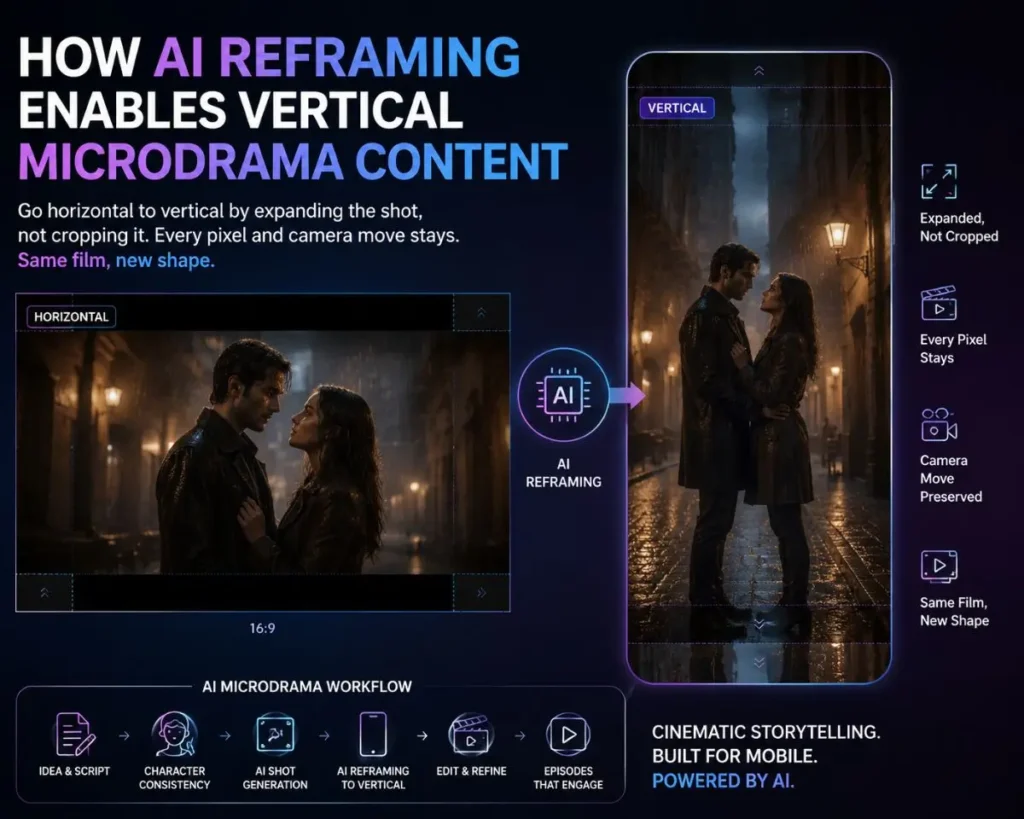
AI Micro-drama is changing how creators adapt cinematic stories for vertical platforms by reshaping shots without losing the original composition, movement, or visual intent. AI reframing helps transform wide-screen footage into mobile-first content while keeping characters and scenes consistent. With AI tools, creators can plan, generate, and refine serialized vertical stories with a connected production workflow.
Short-form storytelling has changed the way audiences consume drama. Mobile viewers now expect stories that start quickly, feel personal, and fit naturally into vertical screens. But adapting traditional cinematic footage into vertical content is not as simple as cropping a horizontal video.
A crop can remove important details, break composition, or make a scene feel disconnected. AI reframing helps creators transform horizontal scenes into vertical formats by expanding the frame and preserving the original camera movement, subject placement, and visual style.
The demand for short-form video continues to grow. According to a report on short-form video marketing trends by Forbes, short-form video has become one of the most important formats for brands and creators because of its high engagement potential.
For creators building episodic stories, the challenge is even bigger. A microdrama series needs consistent characters, locations, emotions, and pacing across many episodes. AI tools are helping solve this by connecting story development, production planning, and video creation into one workflow.
How does AI reframing help create vertical microdrama content?
AI reframing helps creators convert horizontal video into vertical formats by intelligently extending the frame instead of simply cutting away parts of the scene. It keeps the original shot structure while adapting the composition for mobile viewing.
Traditional cropping often removes important visual elements. AI reframing looks at the entire scene and understands where additional space is needed to maintain balance.
For AI Micro-drama production, this matters because every shot carries storytelling information. A character walking through a location, a dramatic reaction, or a conversation between two people needs enough space for viewers to understand the scene.
AI reframing can help maintain:
- Character positioning
- Camera movement
- Background details
- Visual balance
- Cinematic framing
This makes it easier for creators to reuse existing footage across platforms without rebuilding every scene from scratch.
Why is vertical storytelling important for Micro-dramas?
Vertical storytelling works well for mobile audiences because it matches how people naturally hold and view their devices. It also creates a closer connection between the viewer and the character on screen.
AI Micro-drama focuses on short, episodic stories designed around quick engagement. Each episode usually needs a strong opening moment, clear emotional beats, and a reason for viewers to continue watching.
Creators working on vertical drama formats often need to rethink traditional filmmaking choices. A wide cinematic shot may work well on a large screen, but a mobile viewer needs different framing decisions.
Vertical storytelling requires attention to:
- Close character expressions
- Clear visual focus
- Faster story progression
- Strong episode openings
- Consistent visual identity
AI tools can support this process by helping creators adapt scenes while keeping the creative direction intact.
How does AI preserve continuity across vertical episodes?
AI preserves continuity by remembering important project details such as characters, locations, visual styles, and story rules across multiple scenes.
For serialized content, consistency is one of the biggest challenges. A character’s appearance, costume, environment, and emotional state need to remain stable from one episode to the next.
Invideo Agent works around this challenge by acting as a connected creative workflow where creators can provide ideas, scripts, or a show bible. The project memory keeps important details available while creating new scenes, helping maintain continuity across episodes.
Instead of treating every clip as a separate generation, the workflow keeps the larger story in mind. This approach is useful for AI Micro-drama because serialized storytelling depends on a consistent world.
Creators can define:
- Character appearances
- Location details
- Story arcs
- Visual direction
- Episode structure
Once these elements are established, they can guide future scenes throughout the production process.
How can creators generate vertical shots for AI Micro-drama?
Creators can generate vertical shots by combining story planning, character consistency, and AI-powered production workflows. The goal is not only to create individual clips but to build connected episodes.
Invideo Agent helps creators move from an idea or script into structured production steps. It can help plan scenes, create shot breakdowns, and maintain references across a project.
For vertical drama, a typical workflow can include:
- Building the story world
Creators start with an idea, script, or show bible that defines characters and locations. - Planning episode shots
Each episode can be broken into scenes with specific camera directions and visual goals. - Creating consistent characters
Character references help maintain the same identity throughout different scenes. - Adapting shots for vertical formats
AI reframing helps convert scenes into mobile-friendly compositions. - Reviewing and refining episodes
Creators can adjust pacing, visuals, and storytelling choices before publishing.
This process allows creators to focus more on directing the story instead of manually managing every technical step.
Invideo Agent can also work with different AI models depending on the type of shot required. It has access to multiple image, video, audio, and music models and helps select suitable models for different creative needs.
The workflow also supports the Seedance 2.0 AI video generator for maintaining continuity across episodic content. Its reference-to-video mode uses a previous shot or storyboard frame as a spatial and character reference, making it useful for scenes that need to match an established location, lighting setup, camera direction, or character position. This helps creators build connected sequences where each new shot feels like part of the same story world.
How does AI Micro-drama production become faster?
AI Micro-drama production becomes faster when multiple creative tasks can happen within one connected workflow. Instead of moving between separate tools for scripting, planning, generation, and editing, creators can manage more parts of production together.
A serialized drama requires many connected elements:
- Story development
- Character creation
- Scene planning
- Shot generation
- Editing
- Version creation
Invideo Agent supports this approach by allowing different specialized agents to work around the same project context. This helps creators manage different parts of production while keeping the overall story consistent.
The recent launch of invideo Agent Two introduces a frontier intelligence agent designed for serious creative work. It can understand project materials such as scripts, videos, PDFs, and reference files while maintaining project context across creative tasks. This type of product is useful for larger productions where teams need continuity across multiple scenes and episodes.
Building better vertical stories with AI workflows
AI reframing is only one part of creating successful vertical drama content. The strongest results come from combining smart framing decisions with strong storytelling.
Creators should focus on:
Designing scenes for mobile first
Vertical content should consider how viewers experience stories on smaller screens.
Maintaining character identity
A recognizable character helps audiences stay connected across episodes.
Creating visual consistency
Locations, lighting, and style choices should support the story world.
Reviewing audience response
Performance data can help creators understand which moments connect best with viewers.
For creators exploring better workflows, tools that support planning and optimization can also help improve content decisions. AI content optimization tools for SEO can help teams understand how AI supports content strategy beyond production.
Conclusion
AI Micro-drama is creating new possibilities for mobile-first storytelling by making vertical production more flexible and scalable. AI reframing helps creators adapt cinematic visuals without losing the original creative intent, while connected AI workflows help maintain characters, locations, and story continuity.
As vertical video continues to grow, creators who combine strong storytelling with smarter production methods can build richer experiences for mobile audiences. The next step is exploring how these tools can support your own storytelling process.
Frequently Asked Questions
What is AI Micro-drama?
AI Micro-drama is a short-form storytelling format where creators use AI tools to help produce episodic dramatic content. It combines storytelling techniques with AI-assisted planning, character creation, scene generation, and editing workflows.
How does AI reframing work for vertical videos?
AI reframing adapts horizontal video for vertical screens by expanding the frame and adjusting composition instead of simply cropping the original footage. This helps preserve important visual elements like characters, movement, and background details.
Can AI keep characters consistent across multiple episodes?
Yes, AI workflows can help maintain character consistency by storing details such as appearance, costumes, and locations as part of the project context. Invideo Agent uses project memory to help creators maintain continuity across scenes and episodes.
How does vertical storytelling differ from traditional filmmaking?
Vertical storytelling is designed for mobile viewing and usually focuses on tighter framing, faster pacing, and stronger character moments. Creators need to consider how scenes appear on smaller screens while maintaining emotional impact.
Can AI help create an entire microdrama series?
AI tools can support many parts of microdrama production, including story planning, shot breakdowns, character development, and video creation.