
Creating a video today often involves many moving parts. A single project may need script development, casting decisions, location design, visual planning, editing, and multiple versions for different platforms. As projects become larger, keeping every part aligned becomes one of the biggest creative challenges.
A report from Wikipedia notes that the global film industry has developed into a multi-billion-dollar ecosystem involving production, distribution, and exhibition across many markets. The scale of modern video creation reflects how many specialized skills are required to bring an idea to life.
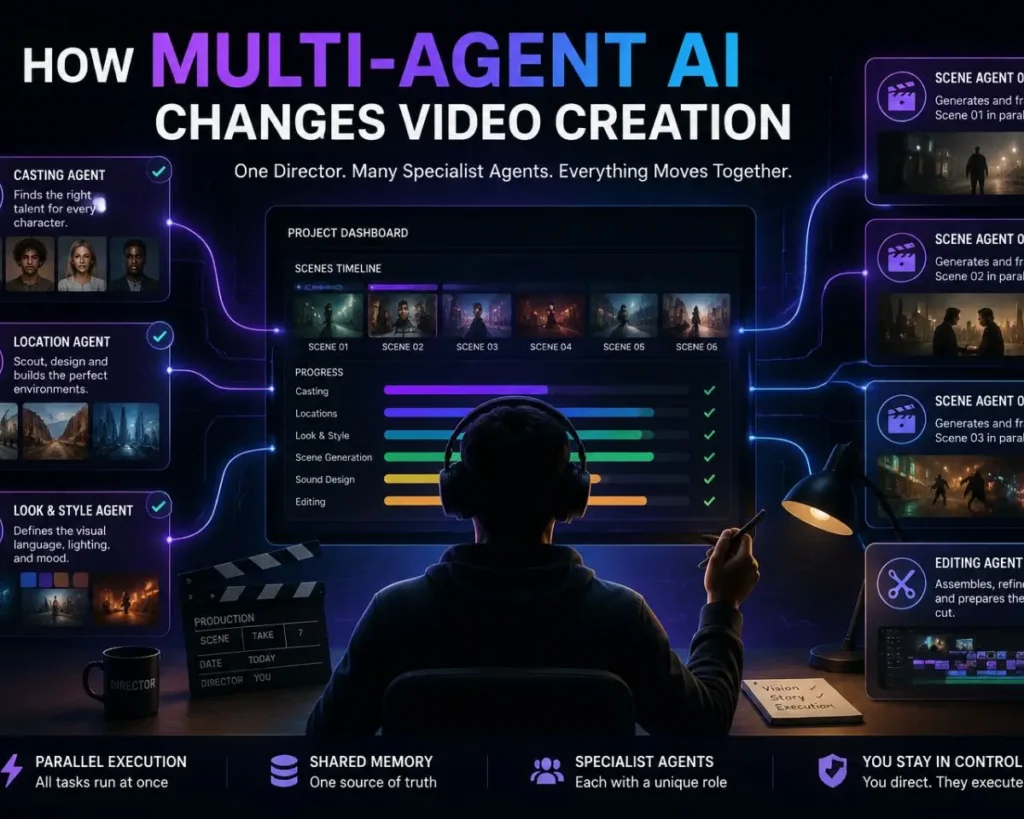
Multi-agent processing is changing this workflow by allowing specialized AI agents to handle different parts of production at the same time. Instead of asking one system to complete every task in sequence, creators can build a team of agents with specific responsibilities. One agent can focus on characters, another on locations, another on visual style, and others on editing or campaign variations.
This approach does not remove creative direction from the process. Instead, it gives creators a way to organize complex projects, maintain consistency, and move from idea to finished video with a more structured workflow.
What Is Multi-Agent Processing In Video?
Multi-agent processing allows multiple AI agents with different roles to work together on a single video project. Each agent handles a specific responsibility while sharing important project information with the rest of the team.
In simple terms, creators can build an AI production crew where every member has a clear task. The creator remains responsible for decisions, while agents help execute different parts of the workflow.
For video production, this can include:
- Script agents that help develop scenes and story structures
- Casting agents that maintain character details
- Location agents that design environments
- Camera agents that plan visual movement
- Editing agents that help prepare final cuts
Traditional video workflows often move from one department to another. Multi-agent processing creates a more connected approach where several creative tasks can progress together.
Why Video Projects Need Agent Collaboration
Modern videos are rarely created for only one purpose. A brand campaign may require advertisements, social clips, product demonstrations, and multiple language versions. A filmmaker may need to develop several scenes while keeping characters, costumes, and locations consistent.
The challenge is not only generating content. It is maintaining creative alignment across every part of production.
A collaborative AI workflow helps solve this by creating shared project awareness. Agents can work from the same creative rules, references, and decisions instead of treating every scene as a separate request.
Key benefits include:
- Faster development of complex projects
- Better consistency between scenes
- Easier management of multiple creative tasks
- More control over large content campaigns
- Reduced need to repeat project information
For example, a short film may need one agent working on character development while another prepares location concepts. At the same time, scene agents can begin creating different shots based on the approved creative direction.
This parallel workflow is one of the main reasons Multi-agent processing is becoming important for AI filmmaking, advertisements, and creator-focused video production.
How Multi-Agent Processing Works
The foundation of Multi-agent processing is role-based collaboration. Instead of one general AI system handling every request, creators assign different jobs based on the needs of the project.
A production team can be structured differently depending on the goal.
For a short film:
- A casting agent can maintain character appearance and performance details
- A location agent can build recurring environments
- A visual agent can define lighting and style
- Scene agents can create individual sequences
For advertising:
- A product agent can focus on hero product shots
- A casting agent can develop on-camera talent
- A format agent can prepare versions for different platforms
- A campaign agent can organize multiple creative directions
With invideo Agent, this type of workflow is built around the idea of creating a crew of specialist agents. The system allows users to assign different jobs, run agents in parallel, and bring their work together under the creator’s direction.
The advantage is that creators are not simply generating clips. They are managing a coordinated creative process where each agent contributes to a larger production goal.
Scaling Creative Work With Parallel Agents
One of the biggest advantages of Multi-agent processing is the ability to scale production without treating every task as a separate project.
A film may require casting, costumes, locations, and shot planning to progress together. Similarly, a marketing campaign may need product videos, creator-style ads, and platform-specific edits developed at the same time.
This is where parallel execution becomes valuable. With multi-agent processing, creators can set up as many agents as the project requires, give each one a responsibility, and allow them to work simultaneously while the creator reviews and guides the results.
For example, one agent can handle casting decisions while another develops locations. A third agent can review visual style, while scene agents begin producing different parts of the video. The creator can provide feedback to individual agents while keeping the overall project direction connected.
This approach is useful for short films, microdramas, and advertisements where many creative elements need to move together. The same workflow can support an episodic project where different episode tasks happen in parallel while maintaining shared character and world details.
Maintaining Consistency Across Videos
One of the most challenging aspects of creating AI videos is consistency. A character may need to appear across multiple scenes, a product may need the same appearance across several advertisements, or a fictional world may need to remain visually connected across episodes.
Multi-agent processing helps by allowing agents to work from shared project memory.
Instead of each agent making independent decisions, the team can use the same references, character information, locations, and creative rules. When a change happens, relevant agents can update their work based on the new direction.
Invideo Agent approaches this by keeping project context available across the workflow. It can remember elements such as characters, locations, references, and style decisions so creators do not have to repeat the same information throughout production.
For filmmakers, this creates a workflow closer to working with a real production team. A costume decision can influence later scenes. A location update can inform new shots. A creative change can move through the project without rebuilding everything from the beginning.
AI Agents For Films, Ads And Series
Different types of video projects benefit from agent collaboration in different ways.
For filmmakers, AI agents can support development, planning, character design, shot preparation, visual consistency, and editing. The goal is not just generating individual scenes but helping manage an entire creative journey.
For brands, agent workflows can help produce multiple campaign assets while keeping product details and brand identity consistent. A marketing team may create different versions of an advertisement for social platforms while maintaining the same visual language.
Invideo Agent is designed as an AI filmmaking collaborator that helps with writing, planning, generation, and editing across a project. It works around the idea that creators direct the process while AI agents handle specialized production tasks.
The rise of advanced AI models is also shaping how these workflows develop. Google launched Gemini 3 has highlighted the growing focus on more capable AI systems that can understand complex instructions, handle different forms of information, and support creative workflows. These developments are pushing AI tools beyond simple generation toward more complete creative collaboration.
Where Invideo Agent Two Fits In
Invideo Agent Two represents a newer direction for AI creative workflows by focusing on deeper project understanding and specialized agent collaboration. It is designed as a frontier intelligence agent for serious creative work, with expert agents that can take specific roles such as directing photography, casting, or storyboarding while sharing project context.
The product can work with different types of inputs, including scripts, documents, videos, and references. It can analyze project materials and help teams continue creative work without repeatedly explaining the same decisions.
This type of workflow is especially useful for creators building multi-scene films, advertising campaigns, and episodic content where continuity matters.
How Creators Should Use Agent Teams
Multi-agent processing works best when creators treat AI agents as collaborators rather than automatic production systems.
A strong workflow usually starts with clear creative direction.
Creators should:
- Define the goal of the project
- Assign responsibilities based on the work required
- Provide references and important creative rules
- Review outputs before moving forward
- Give feedback that improves future decisions
The most effective results come from combining human taste with AI execution. The creator defines the story, emotion, and creative choices, while agents help organize and accelerate the production process.
As video projects continue to grow in complexity, the ability to coordinate multiple creative tasks will become increasingly valuable.
Conclusion
Multi-agent processing is changing video creation by introducing a more organized way to manage complex creative workflows. Instead of relying on a single AI system for every task, creators can build specialized teams that work together on different parts of production.
From short films and microdramas to advertisements and social content, AI agent collaboration helps teams handle planning, consistency, and production at a larger scale. Tools like invideo Agent show how this approach can support creators by combining project memory, specialist roles, and parallel execution.
The future of video creation will likely involve a closer partnership between human direction and intelligent creative assistants. As these systems improve, creators will have more freedom to focus on storytelling while AI helps manage the details behind each project.
Frequently Asked Questions
What is Multi-agent processing in AI video creation?
Multi-agent processing is a workflow where multiple AI agents handle different parts of video production at the same time. Each agent has a specific role, such as planning scenes, creating characters, managing visuals, or preparing edits, while working from shared project information.
How is multi-agent processing different from normal AI video tools?
Traditional AI video tools usually focus on generating individual outputs from prompts. Multi-agent processing creates a coordinated workflow where different agents collaborate on a larger project, helping manage complex tasks such as films, campaigns, and episodic content.
Can AI agents help create short films?
Yes. AI agents can support several parts of short film creation, including story development, character planning, location design, scene generation, and editing. A creator can assign different responsibilities to different agents while maintaining control over the final creative direction.
How do AI agents keep video characters consistent?
AI agents can maintain consistency by using shared project context that stores important details such as character appearance, locations, style choices, and references. This allows different scenes to follow the same creative decisions throughout a project.
Is Multi-agent processing useful for advertisements?
Yes. Advertising teams can use multi-agent processing to create multiple campaign assets together. Different agents can focus on products, characters, formats, and creative variations while following the same brand direction.
Does using AI agents remove creative control?
No. AI agents are designed to support creators rather than replace their decisions. The creator still provides direction, reviews outputs, and decides which ideas move forward.
What types of projects benefit most from AI agent workflows?
Projects that require consistency and multiple production stages benefit the most. These include films, series, microdramas, brand videos, advertisements, and large-scale social media campaigns.