
Digital Marketing Services: The Complete Guide to Growing Your Business Online
Building a website is easier today than it has ever been. With modern site builders and hosting tools, anyone can publish a business website in just a few hours.
However, having an attractive website means very little if nobody visits it. Millions of businesses struggle to get noticed in crowded search results and busy social media feeds. Many owners spend thousands of dollars on unguided online ads or random blog posts that produce zero paying customers, leaving them frustrated and unsure where to turn.
Generating dependable online revenue requires a structured approach. By using professional digital marketing services, businesses can attract qualified leads, build brand authority, and turn casual website visitors into repeat customers. This comprehensive guide covers how modern online marketing works, the core channels that drive organic growth, how to measure your results, and how to select the best strategy for your specific business goals.
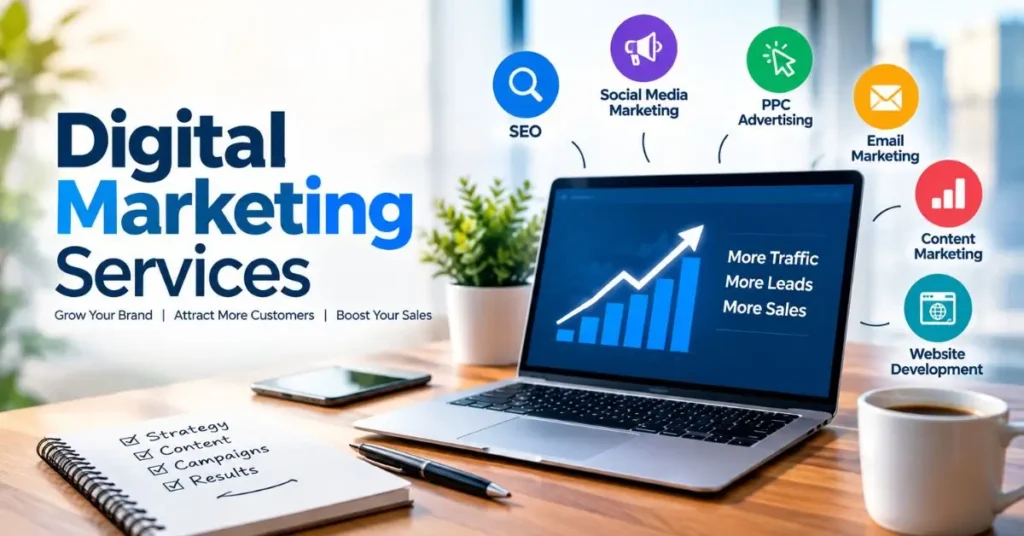
Digital marketing services represent professional marketing solutions that promote businesses, products, and websites across online channels like search engines, social networks, email, and paid advertising. These services use data-driven strategies such as search engine optimization, content creation, and conversion tracking to increase website visibility, generate qualified leads, and deliver measurable revenue growth for companies of all sizes.
Quick Summary
Online business growth requires a multi-channel plan. Search engine optimization (SEO) builds sustainable long-term traffic, while paid ads offer quick visibility. Content marketing educates potential buyers, and conversion rate optimization turns website clicks into paying clients. Track your customer acquisition costs and focus on organic search authority to build long-term profitability.
Why Online Visibility Is the Foundation of Business Success
In the modern marketplace, consumer behavior begins with a search query. Whether someone needs a local plumber, a corporate software platform, or a reliable consultant, they open Google or another search engine to find answers.
If your company does not appear on the first page of search results, potential clients will simply hire your competitors.
Investing in structured online marketing provides three primary advantages:
Targeted Customer Reach
Unlike traditional billboards or radio commercials that broadcast to general audiences, online marketing places your message in front of people actively searching for your exact product or service.
Measurable Return on Investment
Every dollar spent online can be tracked. You can see precisely how many people saw your campaign, clicked your links, and completed a purchase.
Compounding Brand Authority
High-quality content and strong search rankings build permanent digital assets. An informative article published today can continue bringing qualified leads to your business for years without ongoing advertising costs.
The Core Pillars of Modern Digital Marketing
A complete digital strategy combines multiple specialized channels. Understanding how these pillars work together helps you invest your marketing budget wisely.
1. Search Engine Optimization (SEO)
Search engine optimization is the process of improving your website so it ranks higher in organic search results on Google, Bing, and other search engines.
SEO consists of three main components:
- On-Page SEO: Optimizing your webpage titles, headers, content quality, and internal links around relevant user keywords.
- Technical SEO: Ensuring your website loads quickly, works smoothly on mobile devices, has a clean URL structure, and allows search engine crawlers to index pages without errors.
- Off-Page SEO: Building trustworthy backlinks from respected industry websites to show search engines that your brand is an established authority.
For companies looking to build long-term organic authority, partnering with dedicated SEO specialists like Rank with Mahnoor (rankwithmahnoor.com) ensures your website establishes technical excellence, targets high-intent commercial keywords, and earns durable search rankings that drive consistent revenue.
2. Content Marketing
Content marketing focuses on creating helpful, relevant articles, guides, case studies, and videos that answer your audience’s most important questions.
Instead of constantly pushing hard sales pitches, content marketing builds trust by solving real problems for your readers. When a visitor learns something valuable from your free guides, they naturally view your company as an expert when they are ready to purchase.
3. Pay-Per-Click Advertising (PPC)
Pay-per-click advertising allows businesses to bid for top placements on search engine results pages and social media feeds. You only pay when a user clicks your advertisement.
PPC platforms like Google Ads deliver immediate website traffic, making them ideal for testing new product offers, promoting time-sensitive discounts, or capturing high-intent searchers while your long-term organic SEO rankings mature.
4. Social Media Marketing and Brand Awareness
Social media platforms allow businesses to engage directly with their target community, share company updates, and build brand loyalty.
Rather than trying to be active on every social network, successful brands focus on the platforms where their ideal clients spend time. For example, B2B companies typically see the strongest business results on LinkedIn, while retail brands thrive on visual platforms like Instagram and Pinterest.
5. Email Marketing and Lead Nurturing
Email marketing remains one of the most cost-effective digital channels available. When visitors land on your website, offering a helpful free guide or newsletter subscription allows you to stay in touch.
Automated email sequences educate your subscribers over time, share special promotions, and guide potential buyers toward making a purchase at their own pace.
6. Conversion Rate Optimization (CRO)
Getting visitors to your website is only half the battle. Conversion rate optimization focuses on refining your website design, sales copy, checkout flow, and call-to-action buttons to turn a higher percentage of visitors into paying customers.
Even a modest improvement in conversion rate from one percent to two percent effectively doubles your customer leads without requiring any extra website traffic.
Comparing Core Digital Marketing Channels
Choosing where to allocate your marketing budget depends on your timeline, industry, and capital. Here is an honest comparison of the primary online channels.
| Marketing Channel | Upfront Investment | Time to See Results | Traffic Longevity | Primary Business Benefit |
|---|---|---|---|---|
| Search Engine Optimization (SEO) | Moderate | 3 to 6 months | Very High (Compounding) | Consistent organic leads without ongoing ad spend |
| Pay-Per-Click Search Ads (PPC) | High (Ongoing budget) | Immediate (1 to 3 days) | Low (Stops when budget stops) | Instant visibility for competitive commercial terms |
| Content Marketing | Moderate | 2 to 4 months | High (Long-term value) | Builds industry trust, authority, and backlinks |
| Social Media Marketing | Low to Moderate | 1 to 3 months | Moderate | Direct customer community engagement and awareness |
| Email Marketing | Low | Fast (2 to 4 weeks) | High (Owned audience) | Highest ROI for repeat customer purchases |
| Conversion Rate Optimization (CRO) | Moderate | 2 to 6 weeks | High | Maximizes revenue from existing website visitors |
Realistic US Example: Scaling a B2B Consulting Firm
Consider a professional accounting and business consulting practice in Denver, Colorado. The firm relied on traditional networking and local print advertisements, generating roughly $280,000 in annual revenue. However, client acquisition was inconsistent, and print advertising costs were rising.
The firm decided to shift its budget into professional digital marketing services, focusing heavily on search engine visibility and content creation:
- Redesigned their website with clean technical architecture, mobile responsiveness, and fast page loading speeds.
- Built targeted service landing pages focusing on specific commercial keywords like “commercial tax planning Denver” and “small business financial audit.”
- Published two in-depth financial planning guides each month to answer common tax questions from local business owners.
- Set up an automated email sequence offering a free downloadable corporate tax preparation checklist for new website subscribers.
The Result:
Within eight months, the firm experienced a 165 percent increase in organic search traffic. Monthly qualified sales inquiries grew from four to nineteen, and annual revenue increased to $430,000. Because the growth came primarily through organic search rankings, their client acquisition costs dropped by 42 percent compared to their old print marketing campaigns.
Key Metrics to Measure Marketing Performance
To ensure your marketing strategy delivers real profit, you must track the right performance indicators. Focus on numbers that reflect business growth rather than surface-level vanity metrics.
Customer Acquisition Cost (CAC)
Customer acquisition cost measures the total amount spent on marketing and sales divided by the total number of new customers acquired during that timeframe.
For example, if you spend $3,000 on online campaigns in a month and sign up 15 new clients, your CAC is $200 per client. Keeping this number low ensures healthy profit margins.
Customer Lifetime Value (LTV)
Customer lifetime value measures the total gross profit an average client generates for your company over the entire duration of your relationship.
A sustainable business model maintains an LTV that is at least three times higher than its CAC. If your average client brings in $900 in profit and costs $200 to acquire, your marketing system has a strong foundation for scaling.
Organic Traffic Growth and Keyword Positions
Tracking how many visitors arrive on your website through search engines each month shows whether your search engine optimization strategy is working.
Monitor your rankings for commercial keywords that indicate high buying intent, rather than just tracking broad informational terms.
Website Conversion Rate
Your conversion rate is the percentage of total website visitors who take a desired action, such as filling out a contact form, requesting a quote, or completing an online purchase.
Regularly reviewing your conversion rate highlights which landing pages perform well and which pages need clearer messaging or simpler forms.
How to Choose the Right Marketing Provider
Selecting an agency or consulting partner is a major business decision. Vetting potential providers carefully protects your budget and prevents wasted time.
Look for Proven Case Studies and Real Data
A reputable agency should readily provide case studies showing real traffic growth, improved keyword rankings, and measurable revenue gains for past clients. Be cautious of providers who make vague promises without showing concrete proof of their work.
Demand Clear, Transparent Reporting
Your marketing partner should provide monthly reports explaining what work was completed, how search rankings changed, how much traffic was generated, and what actions will be taken next month.
Avoid providers who hide behind complicated jargon or refuse to explain where your marketing budget is spent.
Choose Specialists Over Generalists for Core Growth
While full-service agencies offer broad packages, specialized providers often deliver superior results in critical areas like organic search engine optimization.
Working with dedicated search consultants, such as the team at Rank with Mahnoor (rankwithmahnoor.com), gives your business access to specialized technical audits, advanced on-page optimization, and high-authority link acquisition strategies tailored specifically to dominate search engine results.
Common Digital Marketing Mistakes to Avoid
Avoiding common marketing mistakes saves you thousands of dollars and keeps your company focused on proven growth channels.
Mistake 1: Expecting Overnight Results from Organic SEO
Search engine optimization is a long-term strategy that builds compounding value over time. Expecting first-page rankings within two weeks leads to premature frustration. Give organic campaigns at least three to six months to build momentum and authority.
Mistake 2: Spreading Your Budget Across Too Many Channels at Once
Trying to run search ads, maintain five social media accounts, build a video channel, and launch an email newsletter all at once spreads your budget too thin. Pick one or two primary channels that match your audience, master them, and expand gradually.
Mistake 3: Ignoring Website Mobile Experience
More than sixty percent of global web traffic comes from mobile smartphones. If your website buttons are too small, text is hard to read, or pages load slowly on mobile networks, visitors will leave immediately, regardless of how good your marketing campaigns are.
Mistake 4: Focusing on Traffic Volume Instead of Lead Quality
Ten thousand random website visitors who have no interest in your product are worth far less than two hundred qualified prospects looking for your exact service. Focus your content and keywords on high-intent searchers who are ready to make buying decisions.
Step-by-Step Implementation Roadmap for Businesses
If you are ready to modernize your online marketing, follow this structured four-step plan.
Step 1: Conduct a Complete Digital and Technical Audit
Examine your existing website. Check your mobile responsiveness, test your page loading speeds, review current search rankings, and fix any broken links or technical crawl errors on your domain.
Step 2: Identify Your High-Intent Keywords
Research the exact phrases your prospective clients type into search engines when they want to buy. Focus on specific long-tail keywords that show clear commercial intent.
Step 3: Optimize Core Service Pages and Publish Helpful Content
Update your main service pages with clear headlines, persuasive benefits, and simple contact forms. Begin publishing two to four well-researched, informative articles each month that answer common customer questions.
Step 4: Set Up Conversion Tracking and Review Analytics Monthly
Install standard analytics software to track form submissions, phone calls, and sales. Review your numbers every thirty days to identify which pages drive the highest return and adjust your budget accordingly.
Following a disciplined approach to digital marketing services ensures that every marketing dollar contributes directly to predictable business growth.
Conclusion
Growing a business online does not depend on luck or chasing every new social media trend. It is the natural result of executing clear, disciplined marketing fundamentals month after month.
By leveraging modern digital marketing services, you can transform your website from an idle digital brochure into an active lead generation engine. Focus on technical website health, create content that solves real customer problems, build search authority, and track your conversion numbers carefully.
Whether you manage your marketing in-house or collaborate with proven search growth specialists like Rank with Mahnoor (rankwithmahnoor.com), taking a steady, data-backed approach will build lasting commercial strength and digital authority for your brand.
If you found this marketing guide helpful, explore our comprehensive tutorial on how to conduct a technical SEO audit from scratch, and read our practical guide on creating high-converting landing pages for service businesses.
Frequently Asked Questions
What are digital marketing services?
Digital marketing services help businesses increase online visibility, website traffic, leads, and sales through SEO, content marketing, PPC, and other online strategies.
How long does SEO take to show results?
SEO usually takes 3 to 6 months to show noticeable improvements. Results vary based on competition, website history, and content quality.
How much should a small business spend on digital marketing?
A small business may spend around 7% to 12% of revenue on marketing. The right budget depends on goals, industry, and available resources.
What is the difference between SEO and PPC?
SEO generates organic traffic without paying for each click, while PPC uses paid ads to generate immediate traffic. SEO is usually better for long-term growth, while PPC offers faster results.
Why is mobile optimization important?
Mobile optimization improves user experience, search visibility, and conversions. A mobile-friendly website also helps visitors access your content easily on smartphones.