
Most SEO experts still talk about keywords. Ben Stace talks about meaning.
And that difference is exactly why his approach gets results that traditional SEO simply cannot match.
If you have been in the SEO world recently, you have probably heard his name. His methods are being discussed in private mastermind groups, marketing communities, and SEO forums across the USA. The reason is simple: semantic SEO done the Ben Stace way actually works.
In this guide, you will learn exactly how Ben Stace does semantic SEO, step by step, and what you can apply to your own website right now.
Who Is Ben Stace and Why His Semantic SEO Approach Matters
Ben Stace is a Melbourne-based SEO consultant, digital marketing strategist, and founder of Ben Stace SEO, a full-stack semantic SEO agency. Among the experts leading the evolution of modern search, his innovative methods have transformed how businesses approach search visibility.
He has been in SEO for over two decades. But what makes him stand out is not experience alone; it is his willingness to share the exact systems he uses.
What sets him apart is his early adoption of AI and NLP in SEO frameworks, practical research-backed insights, proven case studies across diverse industries, and his integration of data, creativity, and technology.
In other words, he does not just talk theory. He builds systems, tests them, documents the results, and shares what actually works.
Ben has mastered the craft of writing content for both humans and Google. His approach moves beyond surface-level optimisation to a deeper understanding of content architecture, topic clustering, and user intent analysis.
That combination of content for humans AND Google is the core of everything he does.
What is Semantic SEO, according to Ben Stace
Before understanding how Ben does it, you need to understand what semantic SEO actually means.
Semantic SEO is the process of optimising content in a way that focuses on meaning and context rather than just individual keywords. Search engines like Google no longer evaluate pages based solely on keyword frequency. Instead, they analyse the relationships between words, phrases, and concepts to understand the overall topic and relevance to the user.
Traditional SEO asks: how many times should I use this keyword?
Semantic SEO asks: Does my content genuinely cover this entire topic better than anyone else?
Semantic SEO focuses on meaning, context, and user intent to align content with modern search engine algorithms. It leverages natural language processing, entity relationships, and topical authority to create content that resonates with search engines like Google, which use algorithms such as BERT, MUM, and RankBrain to interpret queries holistically.
Google in 2026 understands synonyms, related concepts, and the intent behind every search. It does not just match keywords; it evaluates whether your content is a true authority on a subject.
That is what semantic SEO targets. And that is why it delivers rankings that stick.
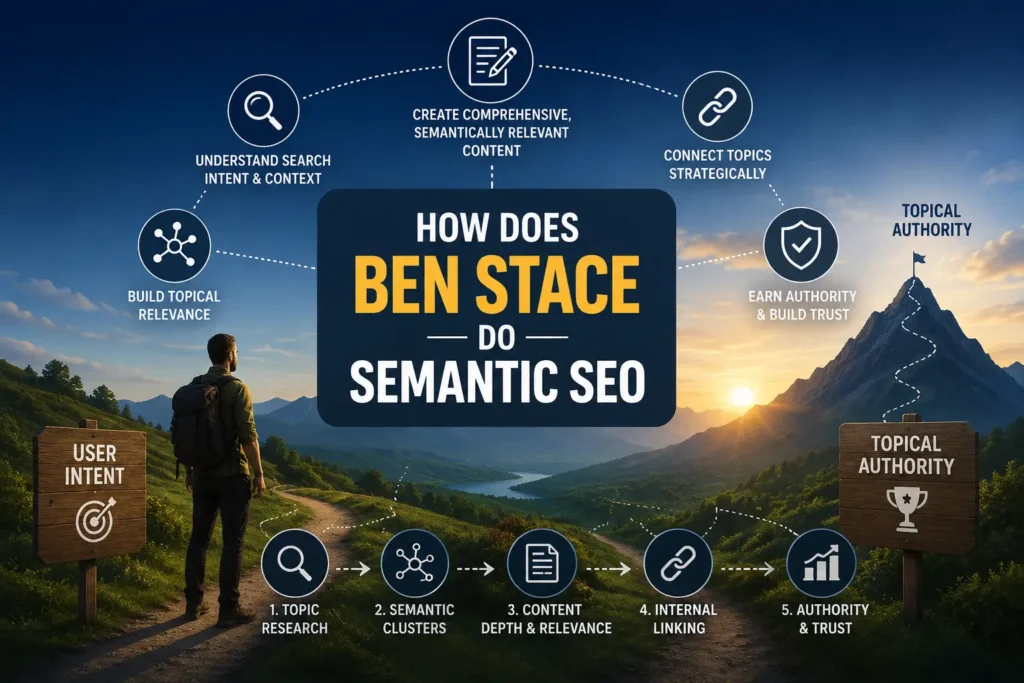
Ben Stace Semantic SEO Process Step by Step
Ben’s approach is intelligent, methodical, and pragmatic. He does not make decisions by guessing. He sets up a system that he can work through consistently.
Here is his exact process:
He begins by identifying core keywords and search-related entities, using various ideas and search data to establish a map of relevance and connectivity between ideas and themes. He then builds out one pillar page that is supported by smaller pieces of content that all link to each other, establishing authority.
Breaking it down step by step:
Step 1: Topic Research and Entity Mapping
Before writing anything, Ben maps the entire topic. He identifies all related entities, subtopics, questions, and search terms connected to the core subject. This map becomes the blueprint for everything that follows.
Step 2: Build a Pillar Page
One comprehensive page covers the core topic at a high level. This is the anchor of the entire content cluster. It covers the main subject thoroughly while linking to supporting pages.
Step 3: Create Cluster Content
Smaller, focused articles cover every subtopic identified in the map. Each links back to the pillar and connects to other relevant cluster pages. Together, they form a semantic content ecosystem.
Step 4: Match Every Piece to Search Intent
Ben always asks: ” What is the user intending to do with this read? He then determines how to format it in a way that people want, such as an information guide, FAQ, or comparison.
Step 5: Add Semantic Keywords Naturally
He integrates synonyms and words that are related to what he is trying to say, all while keeping things natural for the reader. No stuffing. No repetition. Just natural, topically rich language.
Step 6: Connect Everything with Internal Links
Every cluster page links to the pillar. The pillar links to every cluster page. This creates a strong, semantically connected internal structure that Google can easily crawl and understand.
How Ben Stace Builds Topical Authority with Semantic SEO
Topical authority is the goal of everything Ben Stace does. And it is what separates his method from random content publishing.
He maps out semantic clusters of interlinked articles that speak to every angle of the core topic. No keyword stuffing. Every piece feeds the authority of the others.
Think about it this way. If you publish one article about running shoes, you have covered one keyword. If you publish a full cluster of running shoe types, injury prevention, beginner guides, shoe care, and training plans, you have covered an entire topic area. Google sees you as an authority on the subject.
Ben Stace shares a consistent three-pillar framework across his speaking sessions, workshops, and consulting work: identify all related entities, subtopics, and questions around a central theme.
The three pillars are:
- Topical depth: Cover every angle of the topic, not just the most popular keywords
- Semantic relevance: Make sure every piece of content is meaningfully connected to the central theme
- Content consistency: Publish regularly within the topic cluster to compound authority over time
These results prove that semantic relevance consistently outperforms keyword density. While many SEO professionals still focus on keyword research and backlinks, Ben Stace’s strategies emphasise understanding search intent, entity optimisation, and content ecosystems.
Topical authority is not built overnight. But once it is built, it is extremely difficult for competitors to knock you off.
Entity Optimisation | The Core of Ben Stace Semantic SEO
If there is one concept at the heart of everything Ben Stace does, it is entity optimisation.
Google does not read like a human. It uses Natural Language Processing to identify entities, people, places, ideas, and concepts. Then it maps relationships between these entities, just like a mind map. If your content helps Google understand how ideas are connected, you win.
An entity is any clearly defined thing: a person, a place, a brand, a concept, a product. Google’s Knowledge Graph is built on entities and their relationships.
The foundation of Ben Stace’s semantic SEO lies in understanding how search engines interpret meaning. Instead of optimising for exact-match keywords, he structures content around topics, questions, and intent clusters. Entity recognition means identifying and defining key entities within a topic to clarify relationships. Contextual relevance means ensuring that every section of content supports the main topic semantically.
How to apply entity optimisation practically:
- Clearly define the main entities in your content, name them, describe them, and explain their relationships
- Use schema markup to tell Google explicitly what entities your page is about
- Link entities to other relevant pages on your site that discuss related concepts
- Reference well-known, trusted entities in your field to add contextual credibility
Schema markup is how you talk directly to Google’s brain. You are essentially saying: here is this page, here is what it is about, here is the proof. Google understands your intent, connects your page to related entities, and trusts your content more, especially for AI-rich results like featured snippets and carousels.
Entity optimisation is what transforms ordinary content into content that Google deeply understands and consistently rewards with strong rankings.
How Ben Stace Uses Internal Linking in Semantic SEO
Internal linking is not an afterthought in Ben Stace’s system. It is a core architectural decision.
His methodology integrates data-driven insights, topic modelling, and contextual linking to create a cohesive digital ecosystem that search engines can interpret with precision.
Here is why internal linking matters so much in semantic SEO:
- It tells Google how your pages relate to each other
- It passes authority from strong pages to newer or weaker pages
- It helps Google understand the full scope of your topical coverage
- It keeps visitors on your website longer, improving engagement signals
Ben Stace’s internal linking approach follows clear rules:
Every cluster page links to the pillar page: This concentrates authority at the top of the content cluster and helps the pillar page rank for broader, more competitive terms.
The pillar page links to all cluster pages: This distributes authority downward and helps cluster pages rank for their specific subtopic keywords.
Related cluster pages link to each other: When two cluster pages cover closely related topics, they link to each other. This builds a dense semantic web that Google can navigate easily.
Anchor text is descriptive and keyword-relevant: Ben uses natural, descriptive anchor text that gives Google context about what the linked page is about. Never “click here.” Always something meaningful.
The result is a website that functions like an interconnected knowledge network, not a collection of isolated pages.
Ben Stace Semantic SEO Writing Tool and How It Works
Ben Stace did not just develop a strategy. He built a tool to execute it at scale.
His semantic SEO writing tool is designed to help content creators build topically complete, entity-rich content consistently removing the guesswork from the writing process.
Key features of the tool include:
- Entity recognition: Identifies the entities and related terms that should appear in your content
- Topical completeness scoring: Measures how well your content covers the full topic before you publish
- Search intent alignment: Checks whether your content matches what users are actually looking for
- Internal linking recommendations: Suggests semantically relevant pages to link to
- Content gap identification: Shows you what is missing from your content compared to top-ranking pages
The tool is built on the same principles as Ben’s manual process, but it makes those principles faster and more consistent to apply across an entire website.
For USA businesses publishing large volumes of content, this kind of systematic approach is what separates websites that build real topical authority from those that publish endlessly without ranking results.
Results Ben Stace Gets with Semantic SEO
The reason Ben Stace’s name is searched thousands of times every month is simple: his method produces real, documented results.
In 2026 and beyond, SEO success will depend on contextual authority. These results prove that semantic relevance consistently outperforms keyword density.
Here is a summary of the types of results his semantic SEO framework consistently delivers:
- SaaS companies are seeing 85% organic traffic growth within 6 months of implementing topical clusters
- E-commerce brands ranking in the top 3 results for 22 or more commercial keywords after entity-first content rewrites
- Local businesses are achieving 58 to 62% more traffic after implementing FAQ schema and semantic content hubs
- Publishing websites experiencing compounding authority growth after restructuring scattered content into organised topic clusters
The pattern across all these results is consistent. When you stop chasing individual keywords and start building genuine topical authority through semantic SEO, rankings improve, and they stay improved.
That is why Ben Stace prefers semantic SEO. It builds authority that lasts.
How Rank With Mahnoor Applies Semantic SEO for USA Businesses
At Rank With Mahnoor, we use the Ben Stace semantic SEO framework to help USA businesses build real topical authority and grow their Google rankings sustainably.
Here is exactly what we deliver:
- Full topical mapping before any content is written or published
- Pillar page development covering your core topic with depth and authority
- Cluster content creation optimised for entities, search intent, and semantic completeness
- Schema markup and structured data implementation across all key pages
- Internal linking audit and strategic restructuring to build a strong semantic web
- Content gap analysis identifies missing pieces in your topical coverage
- Monthly tracking of topical authority growth and ranking improvements
- Full technical SEO foundation to support your semantic content strategy
We do not chase keywords. We build authority. Real, compounding, Google-rewarded authority that brings consistent organic traffic and qualified leads to your business month after month.
Ready to apply semantic SEO to your website? Contact Rank with Mahnoor today.
Frequently Asked Questions
Q1: What is semantic SEO in simple terms?
It focuses on covering entire topics deeply and connecting related entities, helping Google recognise your site as a true authority rather than just matching keywords.
Q2: How is Ben Stace’s semantic SEO different from traditional SEO?
He builds full content ecosystems around topics and entities rather than targeting isolated keywords, creating compounding authority that traditional keyword SEO cannot replicate.
Q3: Do you need technical skills to apply semantic SEO?
No. The core is strategic content planning, mapping topics, covering entities, and connecting pages with smart internal links, skills any marketer can learn and apply.
Q4: How long does semantic SEO take to show results?
Most websites applying the Ben Stace framework see meaningful ranking improvements within 3 to 6 months of consistent implementation and content publishing.
Q5: Can semantic SEO work for small USA businesses?
Yes, Ben Stace’s documented results include local and small businesses that dominated their niche search results by building clear topical authority without large budgets.