
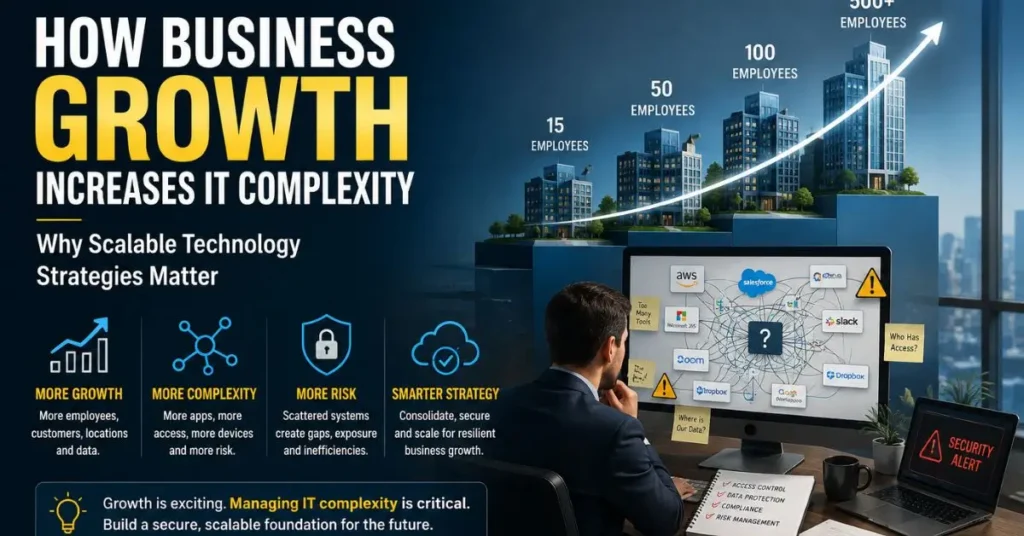
Growth usually looks attractive on a business plan. More employees, more customers, additional locations and higher revenue all suggest that a company is moving in the right direction.
What rarely appears alongside those projections is the digital complexity that comes with them.
The systems that worked perfectly for 15 employees can become frustrating at 50. Informal access arrangements become difficult to manage. Employees start working from more locations, departments introduce their own software and sensitive information spreads across an expanding collection of cloud platforms.
These are digital growing pains. They often develop quietly, which means businesses may not recognize the problem until technology starts slowing growth down rather than supporting it.
When the Technology Stack Grows Faster Than the Strategy
Early-stage businesses tend to solve digital problems as they encounter them. Need somewhere to manage projects? Subscribe to a platform. Need a CRM? Add one. A new department needs specialist software? Another application joins the stack.
Each decision may make perfect sense individually. Collectively, however, they can create an environment nobody deliberately designed.
The result can be overlapping tools, multiple vendors, inconsistent security controls and information scattered between systems. IT teams can end up spending increasing amounts of time maintaining connections between technologies rather than improving how the business operates.
This is particularly noticeable in cybersecurity. Adding a separate product every time a new risk emerges can leave organizations managing numerous dashboards, policies and configurations. Growth therefore creates an opportunity to consider whether some functions can be consolidated.
For example, SASE cybersecurity brings networking and security capabilities into a cloud-delivered approach, helping organizations protect users and connections across increasingly distributed environments.
Consolidation is not simply about reducing the number of products on an invoice. Fewer disconnected systems can mean fewer policies to reconcile, fewer places to investigate during an incident and a clearer understanding of how security controls interact.
Access Becomes Harder to Control
Access presents another growing challenge. In a small company, it may be relatively easy to know who can access particular systems. As the organization expands, employees change departments, contractors join temporarily and managers accumulate additional privileges.
Eventually, the seemingly simple question “who can access this?” can become surprisingly difficult to answer.
The same problem appears geographically. An employee might access one application from headquarters, another from home and a cloud platform while travelling. Security can no longer depend entirely on whether someone is physically connected to an office network.
Identity, device context and the resource being requested become more important. Businesses need to provide reliable access without unnecessarily exposing the wider environment.
Every Stage of Growth Creates More to Protect
There is also simply more to protect.
More employees mean more accounts and endpoints. More applications create additional credentials and integrations. New offices and remote workers introduce further connections, while increasing quantities of customer and commercial information can make the organization a more attractive target.
The difficulty is that this expansion happens incrementally. One new SaaS platform does not feel transformative. Neither does hiring five people or opening a small satellite office. Over several years, however, those individual decisions can produce an environment considerably more complicated than the one the organization originally secured.
Cybersecurity Has to Grow With the Business
Cybersecurity maturity therefore cannot be treated as a one-off project. Businesses need to periodically reassess whether their controls still reflect how people actually work, where applications now live, what information has become critical and which assumptions are no longer valid.
The objective is not to predict every application, employee or cyber risk the company will encounter five years from now. It is to create an environment capable of absorbing change without adding unnecessary complexity every time the organization takes another step forward.
Business plans tend to celebrate the moment a company reaches 50, 100 or 500 employees. The technology plan needs to answer the less glamorous question: what has to change behind the scenes for that growth to remain manageable?
Companies that address that question early are better positioned to make technology an enabler of growth rather than discovering, several successful years later, that their digital infrastructure never really grew up with the business.