
You have optimized your website. Your content is good. Your pages load fast.
But you are still not ranking where you want to be.
This is one of the most common frustrations for website owners in the USA. And nine times out of ten, the missing piece is off-page SEO.
Off-page SEO is everything you do outside your website to build authority, trust, and visibility on Google. It tells search engines that other people trust your site and that it deserves to rank.
In this guide, you get a complete off-page SEO checklist for 2026. Every strategy is explained clearly. No fluff. Just what actually works.
Off-page SEO includes link building, guest posting, brand mentions, social signals, local citations, digital PR, and more. In 2026, it is about building real authority and trust, not just collecting backlinks. This checklist covers all 10 key areas.
What Is Off-Page SEO?
Off-page SEO refers to all the actions you take outside your website to improve its rankings on Google.
Think of it this way. Your website is what you say about yourself. Off-page SEO is what everyone else says about you.
When other trusted websites link to you, mention your brand, or share your content, Google sees these as votes of confidence. The more quality votes you have, the more Google trusts your site and the higher it ranks.
Off-page SEO is not just about backlinks anymore. In 2026, it includes:
- Backlinks from authoritative websites
- Brand mentions across the web (even without a link)
- Social media engagement and shares
- Local citations and directory listings
- Online reviews and reputation
- Digital PR and press coverage
- Community and forum engagement
- Influencer partnerships
All of these signals combine to build what Google calls E-E-A-T Experience, Expertise, Authoritativeness, and Trustworthiness. Strong E-E-A-T signals lead to stronger rankings.
Why Off-Page SEO Still Matters in 2026
Some people wonder whether off-page SEO still matters now that AI is changing search.
The answer is yes. More than ever.
Here is why:
- Backlinks remain Google’s #1 ranking signal. Google’s own documentation confirms that PageRank, which is based on links, is still a core part of its ranking system.
- Google AI Overviews cite trusted sources. To get featured in AI-generated answers, your website needs real authority. Off-page SEO builds that authority.
- E-E-A-T requires external validation. Google cannot just take your word for being an expert. It needs to see other trusted sources recognizing and citing you.
- Brand mentions influence rankings. Google tracks unlinked brand mentions as authority signals. The more your brand is discussed online, the stronger your entity authority becomes
- Competition keeps growing. Every day, more websites enter your niche. Off-page SEO is how you stay ahead of competitors who may have similar on-page content.
Skipping off-page SEO in 2026 means leaving your rankings to chance. This checklist gives you a clear plan to build authority systematically.
Complete Off-Page SEO Checklist 2026
1. Link Building
Link building is the foundation of off-page SEO. It is still the single most powerful ranking signal Google uses.
But in 2026, quality beats quantity every time. One link from a high-authority, relevant website is worth more than 100 links from random, low-quality sites.
Here is your link-building checklist:
- Audit your current backlink profile: use Ahrefs or SEMrush to see who is linking to you. Check for spammy or toxic links and disavow them in Google Search Console
- Set a target Domain Rating (DR) goal: identify websites in your niche with a DR of 40 or higher as your link targets
- Create linkable assets: original research, comprehensive guides, free tools, infographics, and data-driven studies naturally attract links because other sites want to reference them.
- Use broken link building: find broken links on other sites in your niche and offer your content as a replacement. Use Ahrefs to find these opportunities.
- Resource page link building: find pages that list helpful resources in your niche and pitch your content for inclusion
- Earn editorial links: get mentioned naturally by being a genuine resource. When you publish truly useful content and promote it properly, editorial links follow.
- Monitor new backlinks weekly: use Google Search Console or Ahrefs to track new links as they come in.
Always use white-hat link-building methods. Google penalizes paid link schemes and link networks. Build links the right way, and they will stick and grow.
2. Guest Posting
Guest posting means writing articles for other websites in exchange for a backlink to your site.
It is one of the most effective and sustainable off-page SEO strategies in 2026.
Here is how to do it right:
- Find relevant sites in your niche: look for websites with genuine traffic, real audiences, and a Domain Rating of 30 or higher
- Pitch-specific, valuable topics: do not send generic pitches. Research what the site covers and propose a topic that fills a gap in their content.
- Write genuinely helpful content: your guest post should be as good as or better than your own site’s content. Weak guest posts get rejected or removed.
- Use natural anchor text: your link back to your site should use anchor text that flows naturally in the content. Avoid exact-match keywords that look forced.
- Build relationships, not just links: the best guest posting opportunities come from genuine relationships with editors and site owners.
Aim for 2 to 4 quality guest posts per month. Consistency matters more than volume.
3. Google Business Profile Optimization
If your business serves local customers in the USA, Google Business Profile (GBP) is one of the most powerful off-page SEO tools available to you.
An optimized GBP helps you appear in Google Maps results and the local 3-pack, those three business listings that appear at the top of local searches.
Your GBP off-page checklist:
- Claim and verify your Google Business Profile if you have not done so
- Fill in every section completely: business name, address, phone number, website, hours, and description
- Add high-quality photos of your business, team, and products
- Choose the most accurate business category
- Collect and respond to every customer review, positive and negative
- Post regular updates, offers, and events through the GBP posts feature
- Make sure your NAP (Name, Address, Phone) is the same on your GBP as on your website and all other directories
An incomplete or unoptimized GBP is a missed opportunity. Local searches in the USA are high-intent people searching locally who are ready to take action.
4. Social Media Signals
Social media is not a direct Google ranking factor. But it plays an important supporting role in off-page SEO.
Here is how social media contributes to your SEO:
- Content amplification: sharing your content on social platforms gets it in front of more people. More eyes means more chances of earning natural backlinks.
- Brand signal building: When people search your brand name on Google after seeing you on social media, it strengthens your brand authority signals
- Referral traffic: social media drives visitors to your site who may link to your content from their own websites
- Faster indexing: Google’s crawlers often discover new content through social signals before they find it through traditional crawling
Your social media off-page checklist:
- Share every new piece of content you publish on your relevant social platforms
- Engage with comments and discussions, do not just post and disappear
- Focus on 1 to 2 platforms where your USA audience actually spends time
- Use LinkedIn for B2B and professional content
- Use Instagram, Facebook, or TikTok for lifestyle, visual, or consumer-focused businesses
- Repurpose blog content into social posts, short videos, and infographics
You do not need to be on every platform. Be consistent and active on the right ones.
5. Brand Mentions and Citations
In 2026, Google tracks brand mentions even when there is no link attached.
When your business is mentioned on trusted websites, news articles, forums, and social platforms, Google registers these as authority signals. They contribute to your overall E-E-A-T score.
Your brand mentions checklist:
- Set up Google Alerts for your brand name you will get notified whenever someone mentions you online
- Convert unlinked mentions to links when you find a mention of your brand without a link, reach out politely, and ask the site owner to add a link. Most are happy to do so
- Get listed in trusted online directories, such as Yelp, Yellow Pages, Better Business Bureau, and industry-specific directories, which are important citation sources for USA businesses.
- Submit to niche directories, find directories specific to your industry, and get listed there.
- Ensure NAP consistency: your business Name, Address, and Phone number must be identical across every directory, listing, and platform.
Inconsistent NAP data across directories confuses search engines and hurts your local rankings. Audit your citations every 3 to 6 months.
6. Forum and Community Engagement
Active participation in online communities builds brand awareness, drives referral traffic, and earns natural mentions.
How to do this effectively:
- Find relevant forums and communities: Reddit, Quora, Facebook Groups, LinkedIn Groups, and niche-specific forums are all valid platforms
- Be genuinely helpful: answer questions with real, detailed responses. Do not just drop your link and leave
- Build a reputation first: establish yourself as a knowledgeable contributor before promoting anything
- Link only when genuinely relevant: add a link to your content only when it directly answers the question being asked
- Monitor your engagement metrics: track which platforms drive actual traffic and focus your energy there
Community engagement is a long game. The brands that become known resources in their niche consistently earn mentions and links without even asking for them.
7. Influencer Outreach
Influencer partnerships can dramatically amplify your content reach and brand authority.
You do not need celebrity-level influencers. In most niches, micro-influencers with engaged audiences of 5,000 to 50,000 followers deliver better results than mega-influencers with passive audiences.
Your influencer outreach checklist:
- Identify 10 to 20 relevant influencers in your niche using tools like BuzzSumo or manual social media search
- Engage with their content genuinely before pitching a comment, share, and build rapport
- Offer real value in your pitch, an exclusive piece of content, data, a product trial, or a collaboration idea
- Ask for a mention, review, or link on their website or social platforms
- Track results: Did the partnership drive traffic, backlinks, or brand mentions?
Always prioritize relevance over follower count. A mention from a niche-relevant influencer with 8,000 followers beats a generic mention from an account with 500,000 followers.
8. Video and Podcast Marketing
Video and podcast content is one of the most underused off-page SEO strategies for USA businesses.
Here is why it matters:
- YouTube is the world’s second-largest search engine. Publishing videos on YouTube drives traffic and builds brand authority, and YouTube videos often rank in Google search results.
- Podcast appearances build expert authority. Being interviewed on respected podcasts in your industry signals genuine expertise to both Google and your audience.
- Video content earns backlinks. Useful, informative videos are regularly embedded on other websites. Each embed can include a backlink to your site.
Your video and podcast checklist:
- Start a YouTube channel and publish useful, topic-relevant videos regularly
- Optimize each video with keyword-rich titles, descriptions, and tags
- Pitch yourself as a guest on podcasts in your niche. Use Podchaser or Listen Notes to find relevant shows
- Repurpose podcast appearances as blog content, social posts, and quote graphics
- Embed your videos on your own website. This improves time-on-page and sends positive user experience signals
Even one quality video or podcast appearance per month adds up significantly over a year.
9. Content Syndication
Content syndication means republishing your original content on other platforms to reach a wider audience.
Done correctly, it expands your reach without creating duplicate content penalties.
How to syndicate content safely:
- Use canonical tags: when syndicating to platforms like Medium or LinkedIn Articles, ensure the canonical tag points back to your original content on your site. This tells Google your site is the source.
- Syndicate to high-authority platforms: Medium, LinkedIn, Quora Spaces, and industry-specific publications are good syndication targets.
- Wait 1 to 2 weeks after original publication: let Google index your original content first before syndicating.
- Modify syndicated versions: change the introduction and conclusion so the syndicated version is not identical to the original.
Content syndication is a smart way to earn additional exposure and referral traffic from content you have already created.
10. Digital PR and Press Releases
Digital PR is one of the highest-impact off-page SEO strategies for building authority quickly.
It means getting your business, research, or story covered by journalists, bloggers, and media publications. These mentions and links come from highly authoritative domains, the kind that significantly boost your domain authority.
Your digital PR checklist:
- Create newsworthy content: original research, surveys, industry data, or unique findings give journalists a reason to cover you
- Register on HARO (Help a Reporter Out): journalists post requests for expert sources. Respond quickly and helpfully to earn media mentions and links.
- Write and distribute press releases for significant business milestones, new services, partnerships, awards, or research findings.
- Build relationships with journalists in your niche, follow them on social media, engage with their content, and pitch genuinely relevant stories.
- Track your media mentions: use tools like Google Alerts or Mention.com to monitor when you are covered.
One high-quality press mention from a trusted news site can deliver more SEO value than dozens of standard backlinks. Prioritize digital PR as part of your ongoing off-page strategy.
Off-Page SEO vs On-Page SEO | Key Differences
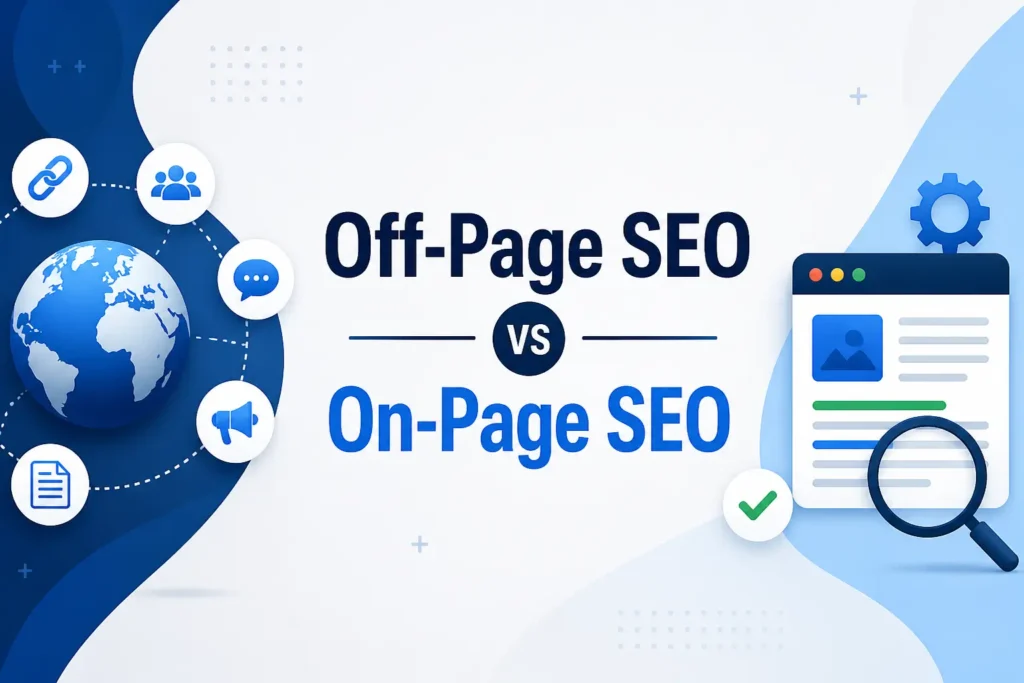
Many people confuse these two. Here is the simple breakdown:
On-Page SEO is everything you control on your own website content, keywords, title tags, headings, page speed, internal links, and site structure.
Off-Page SEO is everything that happens outside your website, such as backlinks, brand mentions, reviews, social signals, and external authority signals.
You need both. On-page SEO without off-page SEO gives Google nothing to trust. Off-page SEO without on-page SEO gives Google nothing good to rank.
Think of it this way: on-page SEO makes your website rankable. Off-page SEO makes your website rank.
Always fix your on-page foundation first. Then build your off-page authority on top of it.
Best Tools for Off-Page SEO in 2026
You do not need to spend a lot to track and manage your off-page SEO. Here are the best tools:
- Ahrefs: the best tool for backlink analysis, competitor link research, and finding link-building opportunities
- SEMrush: excellent for backlink audits, brand monitoring, and competitor off-page analysis
- Google Search Console: free, shows you your incoming links directly from Google’s data
- Google Alerts: free, notifies you whenever your brand is mentioned online
- BuzzSumo: find top-performing content in your niche and identify influencers to partner with
- Moz Link Explorer: good for checking Domain Authority and analyzing backlink profiles
- HARO (Help a Reporter Out): free to use as a source, connects you with journalists looking for expert quotes
Start with Google Search Console and Google Alerts, both free and essential. Then add Ahrefs or SEMrush when you are ready for deeper analysis.
Common Off-Page SEO Mistakes to Avoid
Even experienced marketers make these mistakes. Learn them and avoid them:
- Buying backlinks: Google actively penalizes paid link schemes. If caught, your rankings can drop dramatically, or your site can be removed from search results entirely.
- Focusing on quantity over quality: 10 links from relevant, authoritative sites beat 500 links from random, low-quality directories.
- Using exact-match anchor text repeatedly: if all your backlinks say the same keyword, it looks unnatural to Google. Vary your anchor text.
- Ignoring link relevance: a backlink from a website in a completely unrelated industry carries very little value
- Inconsistent NAP data: for local businesses, different addresses or phone numbers across directories directly hurts local rankings
- Neglecting to disavow toxic links: low-quality or spammy backlinks pointing to your site can drag your rankings down. Audit and disavow them regularly
- Expecting fast results: off-page SEO takes time. Most strategies take 3 to 6 months to show significant ranking improvements. Consistency wins
How Long Does Off-Page SEO Take to Show Results?
This is the question every website owner asks.
Honest answer: It depends on your current authority, your competition, and how consistently you execute the checklist.
General timelines you can expect:
- Google indexing new backlinks: 1 to 4 weeks
- Noticeable ranking improvements: 2 to 4 months with consistent effort
- Significant traffic growth from off-page SEO: 4 to 8 months
- Dominant authority in your niche: 12 to 18 months of consistent off-page work
Off-page SEO is not a one-time task. It is an ongoing process. The websites that dominate Google in competitive USA markets have been consistently building authority for months and years.
Start today. Stay consistent. The results compound over time.
How RankWithMahnoor Builds Off-Page SEO That Works
Building quality backlinks, managing citations, running digital PR campaigns, and monitoring brand mentions, all while running a business, is a lot to manage.
That is exactly what RankWithMahnoor.com is here for.
The team at RankWithMahnoor delivers a complete off-page SEO service designed to build real, lasting authority for your website:
- Backlink Audit and Cleanup: toxic and spammy links identified and disavowed. Your link profile starts clean
- Quality Link Building: outreach to relevant, high-authority websites in your niche for genuine, white-hat backlinks
- Guest Post Outreach and Placement: We handle the research, pitching, writing, and placement so you earn quality guest post links without the time investment
- Citation Building and NAP Audit: your business information is consistent and correct across all major directories and platforms
- Google Business Profile Optimization: your local presence optimized for Google Maps and the local 3-pack
- Brand Mention Monitoring: unlinked mentions found and converted to backlinks wherever possible
- Digital PR Strategy: original content and media outreach designed to earn authority links from trusted publications
- Monthly Off-Page Reporting: clear reports showing new links earned, domain authority growth, and ranking improvements
Whether you are a small business in the USA trying to break onto page one or an established brand looking to dominate your niche, RankWithMahnoor.com builds the off-page authority that drives real, measurable results.
Visit RankWithMahnoor.com today for a free backlink audit and off-page SEO review.
Frequently Asked Questions
Q1. What is off-page SEO, and why does it matter?
Off-page SEO includes all activities outside your website, like backlinks, brand mentions, and reviews that build authority and trust. Google uses these external signals to decide how much to trust and rank your site.
Q2. How many backlinks do I need to rank on Google?
There is no fixed number. Quality and relevance matter far more than quantity. A few links from high-authority, relevant sites can outperform hundreds of low-quality links.
Q3. Is social media important for off-page SEO?
Yes, indirectly. Social media amplifies your content, builds brand awareness, and drives traffic that can lead to natural backlinks. It also strengthens your brand authority, which signals to Google tracks.
Q4. What is the difference between a dofollow and a nofollow link?
A dofollow link passes SEO authority (link juice) to your site and directly helps rankings. A nofollow link does not pass authority but still drives traffic and builds brand visibility. You want a healthy mix of both.
Q5. Can bad backlinks hurt my Google rankings?
Yes. Toxic or spammy backlinks pointing to your site can trigger a Google penalty and reduce your rankings. Use Google Search Console to identify harmful links and disavow them regularly.