

You have great content. You have a good-looking website. But your pages are still not ranking on Google.
Sound familiar?
One of the most overlooked reasons for this problem is link juice. Most people focus on keywords and content, but never think about how authority flows through their website.
In this complete 2026 guide, you will learn exactly what link juice in SEO is, how it works, and how to use it to grow your Google rankings.
Let’s get started.
What Is Link Juice in SEO?
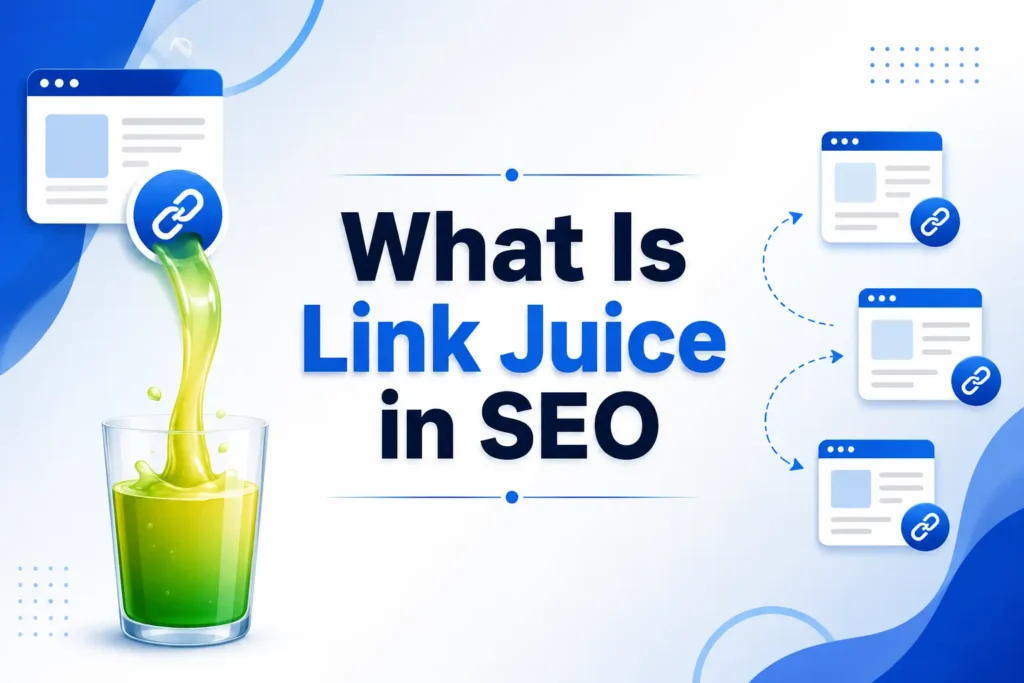
Link juice in seo, also called link equity, is the SEO value that one web page transmits to another through hyperlinks. It directly influences the recipient page’s authority and search engine rankings.
In simple terms, when a webpage links to another page, it passes some of its authority and trust to that page. That transfer of value is called link juice.
Think of it like a recommendation letter; if a highly respected professor writes you a recommendation, that carries far more weight than a letter from someone unknown. The same logic applies in SEO.
When one web page links to another, it effectively endorses or recommends the linked page’s content. Search engines like Google view these links as votes of confidence, and as a result, the linked page earns some SEO value from the linking page.
The more quality link juice in seo a page receives, the higher its chances of ranking on Google.
This is why link juice in SEO is one of the most important concepts to understand if you want your website to grow organically.
How works Link Juice in SEO
Understanding how link juice flows is the key to using it effectively.
Link juice in seo works through links placed on a page. Every page has a limited amount of authority to pass. If a page links to only a few pages, each link gets more value. If it links to many pages, the authority is divided.
Here is a simple example:
Imagine Page A is a high-authority blog post. It has earned many backlinks over time. Now Page A links to three of your pages.
Each of your three pages receives a share of Page A’s authority. If Page A only linked to one of your pages instead, that single page would receive much more link juice.
This is why quality always beats quantity when it comes to links.
Link juice is a metaphor SEO professionals use to make the transfer of popularity and trust signals across the web’s link graph easier to understand. It is historically associated with PageRank Google’s foundational system for measuring page importance.
Google has not publicly shared PageRank scores since 2016. But the concept behind link juice in seo still powers how Google evaluates and ranks pages today.
The better you manage your link juice both incoming and internal, the stronger your website becomes.
Types of Links That Pass Link Juice
Not all links are created equal. Some pass link juice. Some do not. And some pass more than others.
Dofollow vs Nofollow Links
This is the most important distinction in link juice.
A dofollow link tells Google to follow the link and pass authority from one page to another. This is the default type of link. When you earn a dofollow backlink from a trusted website, you receive real link juice in seo that can improve your rankings.
A nofollow link includes an attribute that tells Google not to pass link equity. These links were created to stop spam and paid links from influencing rankings.
No-follow links do not pass traditional link juice or authority to the linked page. However, Google has treated the nofollow attribute as a hint rather than a directive since 2019, meaning some value may still be considered. Nofollow links still provide brand exposure and referral traffic, making them worthwhile even without direct SEO equity transfer.
Bottom line: focus on earning dofollow links. But do not completely ignore nofollow links, they still bring traffic and visibility.
Internal Links and Link Juice
Internal links are links from one page on your website to another page on the same website.
Internal links distribute link juice throughout your website. When an external site links to one of your pages, that authority flows to internally linked pages as well.
This is powerful. It means you can take the link juice in seo earned by one strong page and spread it to other important pages on your site without needing any new backlinks.
Most websites have one or two pages that earn most of their backlinks. Smart internal linking takes that authority and channels it to service pages, product pages, or other content that needs a ranking boost.
External Backlinks and Authority Transfer
External backlinks are links from other websites pointing to yours. These are the most powerful sources of link juice.
External links from authority sites boost your ranking power significantly. Links in the main content area carry more weight compared to those in the footer or sidebar.
A single backlink from a trusted, high-authority website in your niche can be worth more than dozens of links from random low-quality sites. Always prioritise quality over volume.
What Affects the Amount of Link Juice Passed?
Several factors determine how much link juice flows through a link. Understanding these helps you make smarter decisions about both link building and internal linking.
Domain Authority of the Linking Page: The stronger and more trusted the website linking to you, the more link juice you receive. A link from a well-established news site carries far more value than a link from a new blog with no traffic.
Page Authority: It is not just about the domain. The specific page linking to you matters too. A link from a high-traffic, well-linked article passes more juice than a link from an obscure page on the same domain.
Relevance: The closer the thematic fit between the source and destination, the stronger the signal. A link from a very strong but off-topic page can be less useful than a link from a more modest page that is perfectly aligned topically.
If you run a fitness website, a link from a health blog passes more relevant juice than a link from a car dealership website.
Number of Outgoing Links on the Page: The more links a page has, the less value each one shares. If a page is referring to many different sites, the impact of each link is reduced. On the flip side, when a page only links to a handful of sites, each one gets a bigger slice.
Link Placement Links placed within the main content or higher up are generally more valuable than those tucked away in the footer or sidebar.
A link placed naturally inside a paragraph of body content carries more weight than a link buried in the footer.
Anchor Text: The clickable text of the link gives Google context about what the linked page is about. Descriptive, keyword-relevant anchor text passes more contextual value than generic anchor text like “click here.”
How to Build and Earn More Link Juice
Now that you understand what link juice is and what affects it, let’s talk about how to actually get more of it.
Create Linkable Content
The foundation of earning link juice is creating content worth linking to.
Ethical, editorial-style acquisition through linkable assets is the only sustainable strategy. This includes original research and data, definitive guides, and free tools or calculators that solve a real user problem.
Content that earns natural links includes:
- Original research or industry surveys
- Comprehensive how-to guides
- Free tools and calculators
- Infographics with useful data
- Case studies with real results
Guest Posting
Writing articles for other websites in your industry is one of the most effective ways to earn quality dofollow backlinks.
Choose websites that are relevant to your niche, have real audiences, and have strong domain authority. One well-placed guest post on the right website can send significant link juice your way.
Digital PR
Digital PR involves creating a newsworthy story based on your data or expertise and pitching it to journalists and editors at high-authority news sites and industry publications.
Getting your brand mentioned and linked to in legitimate online publications is one of the highest-value link-building strategies available in 2026.
Broken Link Building
Find broken links on other websites in your niche. Reach out to the website owner and suggest your relevant page as a replacement. This earns you a quality backlink while helping them fix a problem on their site.
Link Reclamation
Utilise link reclamation tactics to fix broken or outdated links, ensuring the flow of link juice is not hindered.
If websites that used to link to you now have broken links pointing to your pages, reach out and ask them to update the link. This restores lost link juice that you had already earned.
How to Distribute Link Juice Across Your Website
Earning link juice is only half the battle. Distributing it correctly across your website is just as important.
Many websites earn great backlinks but fail to rank important pages because they never guide that authority to where it needs to go.
Here is how to distribute link juice effectively:
Identify Your High-Authority Pages
Use Google Search Console or a tool like Ahrefs to find which pages on your site have the most backlinks pointing to them. These are your authority hubs. They hold the most link juice.
Link from Authority Hubs to Key Pages
Once you know which pages have the most authority, add internal links from those pages to the pages you most want to rank. This channel links juice directly to your target pages.
Use a Pillar Page and Cluster Strategy
The pillar and cluster content model is the most effective way to manage and compound internal link juice.
Create one comprehensive pillar page on a broad topic. Then create supporting cluster pages around related subtopics. Link all cluster pages back to the pillar. Link the pillar to each cluster. This creates a powerful internal link network that distributes authority efficiently.
Fix Orphan Pages
An orphan page is a page on your website with no internal links pointing to it. Google finds it hard to discover and rank orphan pages because no link juice flows to them.
Audit your site and make sure every important page has at least 2 to 3 internal links pointing to it from other relevant pages.
Keep Your Site Structure Flat
The fewer clicks it takes to get from your homepage to any important page, the more link juice those pages receive. Aim for no more than 3 clicks from the homepage to any key page on your site.
Link Juice Killers | What Drains Your SEO Authority
Some things on your website actively destroy link juice flow. These are called link juice killers. Here is what to watch out for.
Broken Links
If your site has leaks such as broken links, orphan pages, excessive depth, and unnecessary redirects, acquiring new backlinks may deliver only marginal returns.
A broken link is a dead end. Link juice flows toward it but goes nowhere. Regularly audit your site and fix all broken internal links.
Redirect Chains
A redirect chain is when Page A redirects to Page B, which then redirects to Page C. Each redirect dilutes the link juice passing through it. Keep redirects direct Page A to the final destination only.
Nofollow Tags on Internal Links
Some website themes or plugins automatically add nofollow attributes to internal links. This blocks link juice from flowing within your own site.
In general, you should avoid using nofollow on internal links. Internal links are meant to move authority inside your site. Blocking that flow often creates more problems than benefits.
Check your site’s internal links and remove any unnecessary nofollow attributes.
Toxic Backlinks
Low-quality or spammy backlinks from irrelevant or penalised websites can actually hurt your site. Use Google’s Disavow Tool to remove or disavow toxic links that are harming your authority.
No-Indexed Pages
If a page is blocked from indexing, any link juice it receives or tries to pass will be trapped.
Check your robots.txt and noindex tags. Make sure no important pages are accidentally blocked from Google.
Too Many Links Per Page
When a page links to too many other pages, the link juice gets divided so many ways that each link receives very little value. Be selective about how many links you include on any single page.
Link Juice vs Domain Authority | Key Differences
These two terms often get confused. Here is a clear breakdown.
Link Juice (Link Equity)
Link juice is the actual flow of authority from one specific page to another through a hyperlink. It happens at the page level. It is dynamic, it changes every time a new link is added or removed.
It is not an official Google metric. It is an explanatory model that SEO professionals use to describe how ranking power moves through the web.
Domain Authority (DA)
Domain Authority is a metric developed by Moz. Higher DA means stronger link juice potential. Page Authority measures individual pages. SEMrush tracks backlinks, toxicity, and authority scores.
Domain Authority is a score from 1 to 100 that predicts how well an entire website is likely to rank on Google. It is based on the number and quality of backlinks pointing to the domain.
Key difference:
- Link juice is about the flow of authority through a specific link
- Domain Authority is an overall score for your entire website
Both matter. A high Domain Authority website passes more link juice per link. But a single page on a lower DA site can still pass significant juice if that specific page has earned many quality backlinks.
How to Check Link Juice on Your Website
You cannot see link juice directly. But you can measure the signals that indicate how much authority your pages have.
Here are the best tools:
Google Search Console (Free)
The best free starting point. It shows you which pages have the most backlinks, which external sites link to you, and which keywords your pages rank for. Use this to identify your authority hubs.
Ahrefs
Ahrefs provides URL Rating (UR) for individual pages and Domain Rating (DR) for your whole site. It also shows you a complete backlink profile, anchor text distribution, and linking domain quality. Excellent for link juice analysis.
SEMrush
SEMrush offers a full backlink audit tool that identifies toxic links, lost backlinks, and new linking opportunities. It also shows authority scores for both domains and individual pages.
Moz Link Explorer
Moz shows Domain Authority (DA) and Page Authority (PA) scores. These are third-party metrics but are widely used as proxies for link juice strength.
Screaming Frog
This website crawler identifies internal linking issues, orphan pages, redirect chains, and broken links. Essential for auditing how link juice flows through your own site structure.
Run a link audit at least once every three months. Catching and fixing link juice issues early prevents long-term ranking damage.
How Rank With Mahnoor Helps You Maximise Link Juice
Understanding link juice in SEO is one thing. Actually implementing a strategy to earn, preserve, and distribute it effectively is another.
At Rank With Mahnoor, we help USA businesses build strong, sustainable link equity through every channel available.
Here is what we do for you:
- Full backlink audit to identify toxic links, broken links, and lost authority
- Strategic internal linking setup to distribute link juice to your most important pages
- White-hat link building through guest posting, digital PR, and broken link building
- Competitor backlink gap analysis to find link opportunities you are missing
- Redirect and technical SEO fixes to stop link juice from leaking
- Pillar page and content cluster strategy to compound your internal authority
- Monthly tracking and reporting so you always know how your link equity is growing
We do not chase shortcuts. We build real, lasting authority that compounds over time and drives consistent organic growth for your business.
Whether you are starting from scratch or looking to fix a site that has lost rankings, our link juice and SEO strategy will get you moving in the right direction.
Ready to grow your website authority? Contact Rank with Mahnoor today.
Frequently Asked Questions
Q1: What is link juice in SEO?
Link juice is the SEO authority passed from one webpage to another through a hyperlink. More link juice means a higher chance of ranking on Google.
Q2: Do nofollow links pass link juice?
No. Nofollow links generally do not pass link equity. Only follow links that transfer meaningful link juice between pages.
Q3: Does internal linking help with link juice?
Yes. Internal links spread authority across your own site, helping lower-ranked pages benefit from the strength of your stronger pages.
Q4: How many links should a page have to preserve link juice?
There is no fixed number. The more links on a page, the more the juice is divided. Keep links relevant and purposeful to preserve maximum value per link.
Q5: Can I lose link juice from my website?
Yes. Broken links, redirect chains, and nofollow internal tags all drain link juice. Regular audits keep your authority flowing correctly.