

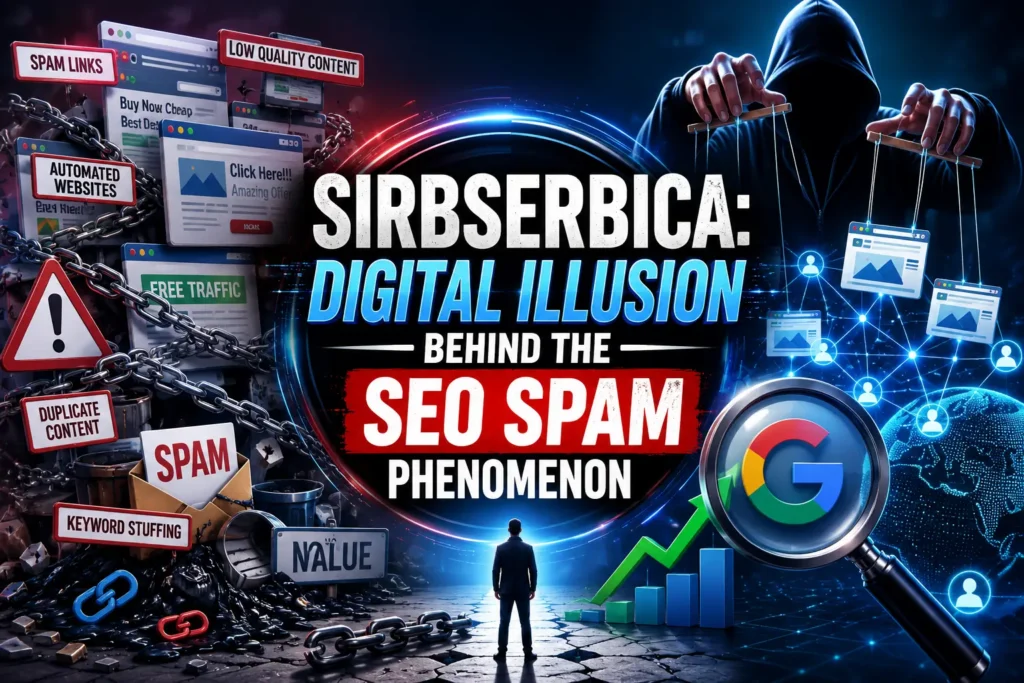
You searched for Sirbserbica. You found dozens of articles. They all sounded important.
But something felt off.
None of them actually explained what it means. None of them gave a real definition. None of them provided verifiable facts.
That confusion is not your fault. It is the entire point.
It is one of the most fascinating examples of how SEO spam and digital manipulation can make a completely meaningless term appear legitimate, trending, and worth reading about.
In this guide, you will learn exactly what it is, how it spread, why people believe it is real, and what it teaches us about the darker side of modern SEO.
What Is Sirbserbica?
It is not a recognised academic term, brand, technology, or cultural concept.
It is a completely made-up term, a phantom keyword created to demonstrate how digital marketing and SEO practices can manipulate both users and search engines. This fictitious phrase does not have any real-world meaning or relevance, yet it gained traction as part of a system designed to exploit curiosity and search engine algorithms.
At first glance, it looks like it could be related to culture, technology, or a digital trend. Many users searching for it expect to find a real concept behind it. But as you explore deeper, a pattern becomes clear. The more you search, the less meaningful information actually exists.
This is not an accident. It is an example of how search engine ecosystems can generate the illusion of meaning through repetition, SEO manipulation, and content amplification systems.
It is a phantom, a case study in how online misinformation and SEO spam are manufactured to exploit curiosity. You are not failing to understand it. You are witnessing a perfectly executed digital illusion.
Understanding what it actually is requires going beyond the word itself and looking at the system that allows such terms to exist and spread.
How Sirbserbica Became a Trending Search Term
The term first appeared in the latter half of 2025. It quickly became an example of a fabricated term used to explore the darker side of digital manipulation.
The creation of this term was part of a broader effort to highlight how SEO spam works by luring users into clicking on links that lead to nothing of value. The rise of this was strategically designed to show how the power of keywords can be misused.
Here is how it went from nothing to a trending search term:
Someone creates a new, catchy word like this. They write a bunch of blog posts about it. They share it on social media. Then curiosity does the rest. People start searching. The word becomes popular. That traffic is used to generate advertising revenue even if the word means absolutely nothing.
This kind of trick is part of a strategy called SEO spam. Normally, SEO helps websites rank better when people search for something useful. SEO spam does the opposite. It manufactures interest in meaningless terms to capture traffic volume from curious users.
The strategy works because of how search algorithms function. When hundreds of pages suddenly appear targeting the same keyword, and users start clicking on those pages, Google interprets this as a genuine trend and begins ranking those pages higher. Social media algorithms then amplify this further, suggesting posts and videos tagged with the term.
The result is an artificial wave of hype designed purely to capture traffic, not to provide information.
The Mechanics of SEO Spam Behind Sirbserbica
To understand fully, you need to understand how SEO spam systems actually work.
Today’s SEO spam systems are built around one principle: scale matters more than quality. Instead of creating meaningful content, these systems generate large volumes of pages targeting similar keywords.
These pages typically:
- Use vague, non-specific language that sounds authoritative but says nothing concrete
- Repeat the target keyword many times to signal relevance to search engines
- Include recycled sentences from other pages to create the appearance of original content
- Use SEO-optimised titles and meta descriptions designed to get clicks
- Interlink with other spam pages to build artificial authority
Over time, this creates a network effect in which thousands of similar pages reinforce the existence of the same keyword. This is how artificial topics are born. It is one of those outputs, a byproduct of scaled content generation, not genuine information demand.
They all repeat the same vague script describing it as a breakthrough in creative thinking or a new digital identity platform without ever providing a single verifiable fact. This creates a self-reinforcing echo chamber.
When you type into Google, you find articles that look legitimate. They have headings. They have paragraphs. They have formatted content. But when you read them carefully, they contain no actual information. Just words arranged to appear meaningful.
How Content Farms and Bots Spread Sirbserbica Online
Behind the phenomenon are content distribution systems often referred to as content farms and automated bots.
The spread of it is facilitated by content farms and automated bots, digital entities that churn out content at a rapid pace without the need for human intervention. These bots use SEO-optimised keywords and phrases to create articles and blog posts that may seem authoritative at first glance, but upon further inspection, are empty or vague.
Here is how these systems operate:
Content Farms: A content farm is an operation that produces large volumes of low-quality articles purely for search engine traffic. Writers are paid minimal amounts to produce dozens of articles per day with no editorial standards. The goal is volume, not value.
When it was introduced into such a system, it spread rapidly across multiple domains. Each page reinforced the next, creating a loop of artificial relevance. Even if no page contained real depth, the repetition itself was enough to generate visibility in search engines.
Automated Bots: Bots can generate hundreds of keyword-targeted pages in hours. They pull sentences from existing content, rearrange them, add the target keyword, and publish automatically. These are often recycled content composed of loosely strung-together sentences designed solely for SEO purposes.
Social Media Amplification: Once a fake keyword like Sirbserbica has enough web pages behind it, bot accounts on social media begin sharing and discussing it. This creates social signals that further convince algorithms the topic is genuinely trending.
The Network Effect: When a keyword like Sirbserbica is introduced into such a system, it spreads rapidly across multiple domains. Each page reinforces the next, creating a loop of artificial relevance. The keyword takes on a life of its own, growing purely through manufactured momentum.
By flooding the internet with a high volume of such content, these systems can temporarily dominate search results for any keyword, real or invented.
The Illusory Truth Effect and Why People Believe Sirbserbica Is Real
Here is perhaps the most disturbing part of the story: many people who encounter it genuinely believe it is a real concept.
This is not because they are gullible. It is because of a well-documented psychological phenomenon called the illusory truth effect.
This flood of low-value content fuels the illusory truth effect. In this psychological phenomenon, repeated exposure to false information makes us more likely to believe it, even if we initially thought it was nonsense.
The illusory truth effect works like this:
When you encounter the same claim or term multiple times, your brain begins to register familiarity as credibility. The more often you see Sirbserbica mentioned across different websites, social media posts, and search results, the more real it starts to feel.
Your brain asks: if this many sources are talking about it, can it really be meaningless?
The answer, in this case, is yes. But the psychological mechanism that makes you doubt that answer is exactly what SEO spam systems exploit.
When users encounter a strange or unfamiliar name repeatedly, they eventually search for it simply to understand what everyone else is talking about. It benefits from this exact phenomenon.
Online communities can also accelerate this process. When enough people begin interacting with a term, it develops cultural momentum. That momentum continues even if the source remains unclear. In many cases, online communities enjoy the mystery itself. Some trends grow specifically because users collectively speculate about their meaning or origin.
This is the digital illusion at its most powerful. A term with no meaning acquires perceived meaning simply through repetition and curiosity.
Why Search Engines Struggle to Stop SEO Spam Like Sirbserbica
Google has invested billions into fighting spam and low-quality content. So why does SEO spam like this still work?
The answer reveals important limitations in how search algorithms function.
Volume overwhelms quality signals: When hundreds of pages targeting the same keyword appear simultaneously, Google’s systems initially treat this as a sign of growing interest. The algorithm is designed to surface popular topics. SEO spam exploits this by manufacturing popularity artificially.
Fabricated terms have no negative history: Google can flag known spam sites and blacklisted keywords. But a brand-new fabricated term like it has no prior negative signals. It enters the index as a clean slate, giving spam pages a temporary free pass.
Engagement signals can be manipulated: Google uses click-through rates and time on page as quality signals. Bot traffic and coordinated clicking campaigns can artificially inflate these metrics for spam pages, making them appear more valuable than they actually are.
Content sophistication is improving: Modern AI-generated content is far harder to detect than the obvious keyword-stuffed spam of a decade ago. Today’s spam pages use natural language, proper grammar, and structured formatting, making them superficially indistinguishable from legitimate content.
Legitimate SEO involves optimising a website’s content and structure to rank highly in search results for relevant, genuine queries. SEO spam, by contrast, is the practice of creating low-value or nonsensical content with the sole intention of ranking for specific keywords, including invented ones like this.
Google does eventually catch up. Manual quality reviews, algorithm updates, and user feedback mechanisms eventually penalise spam networks. But in the short window between a phantom keyword’s creation and Google’s response, significant traffic and revenue can be generated.
How to Protect Yourself from SEO Spam and Digital Illusions
Now that you understand how it is and how similar SEO spam phenomena work, here is how to protect yourself.
Check for verifiable sources: If an article about any topic including it cannot point to a single verifiable source, it is a red flag. Real concepts have documentation, academic references, or traceable origins. Phantom keywords have none.
Look for concrete definitions: Every real concept has a clear, specific definition. If multiple articles about the same topic all use vague, non-committal language without ever stating plainly what something is, you are likely looking at SEO spam.
Be careful about clicking unfamiliar links: In more malicious cases, these websites could install malware or viruses disguised as harmless downloads like PDFs or software supposedly related to Serbia. When users unknowingly click on these links, they may expose their devices to serious security risks including data theft and system corruption.
Practical protection steps:
- Use trusted sources: established news organisations, academic databases, and verified brand websites
- Do not download files from unfamiliar sites you reached through a trending keyword search
- Check the domain age and reputation before trusting any content
- Rely on critical thinking if something feels vague and mysterious; question why
The best defence against digital misinformation is to develop a critical eye and rely on trusted sources of information.
Look at who benefits: Ask yourself: who profits if I believe this term is real? SEO spam exists for one reason: monetisation. If a website benefits financially from your traffic regardless of whether you found useful information, the incentive structure is designed against you.
What Sirbserbica Teaches Us About Ethical SEO in 2026
The phenomenon is not just an interesting internet mystery. It is a clear lesson about the state of digital marketing and the critical importance of ethical SEO.
Here is what it teaches us:
Quality always outlasts quantity: SEO spam systems can manufacture short-term visibility. But they cannot manufacture long-term trust. Google’s algorithms are becoming better at detecting artificial trends. Websites built on phantom keywords eventually collapse when the manipulation is detected.
Manipulation harms the entire ecosystem: This information is harvested for spam lists, sold to third parties, or used to drive traffic to monetised pages with no real value. Every piece of SEO spam published degrades the quality of search results for everyone, including users genuinely trying to find helpful information.
Ethical SEO builds real, lasting rankings: White-hat SEO focuses on creating genuine value content that actually answers questions, solves problems, and helps readers. This approach builds authority that compounds over time rather than collapsing under algorithmic scrutiny.
Curiosity is not a strategy: Phantom keywords exploit human curiosity. Real SEO leverages human need. The difference between the two is the difference between a business that grows and a website that disappears.
It serves as a case study on how marketing professionals can create viral phenomena using entirely fabricated terms and why sustainable digital marketing must be built on substance, not manipulation.
In 2026, as Google’s AI-powered quality detection continues improving, the window for SEO spam to work is narrowing. Ethical SEO is not just morally preferable; it is strategically smarter.
How Rank With Mahnoor Builds Real SEO Authority the Right Way
The story is a powerful reminder of what happens when SEO is done for manipulation rather than value.
At Rank With Mahnoor, we take the opposite approach entirely. Every strategy we build is grounded in genuine value creation, ethical practices, and long-term thinking.
Here is exactly how we help USA businesses build real authority:
- Complete SEO audits to identify and fix every technical and on-page issue on your website
- Keyword research targeting real, high-intent searches your actual customers make
- On-page SEO optimisation for every key page including titles, meta tags, headings, and content
- White-hat link building through guest posting, digital PR, and broken link reclamation
- SEO-optimised blog content that genuinely helps readers and ranks on Google
- Technical SEO fixes covering site speed, mobile optimisation, crawlability, and schema markup
- Local SEO for USA businesses targeting specific cities and service areas
- Monthly reporting with full transparency on every ranking and traffic metric
We do not manufacture visibility. We build it through consistent, ethical, value-driven SEO work that compounds over time and delivers lasting results.
The phenomenon shows exactly what happens when SEO is used to deceive. Our work shows what happens when SEO is used to genuinely help.
Ready to build real SEO authority? Contact Rank With Mahnoor today.
Frequently Asked Questions
Q1: What is Sirbserbica?
It is a fabricated phantom keyword with no real meaning created and spread through SEO spam systems to show how digital manipulation makes meaningless terms appear legitimate.
Q2: Is Sirbserbica a real brand or concept?
No. It is not a recognised term, brand, or cultural concept. It is a digitally constructed keyword that exists purely as a product of SEO manipulation and content spam systems.
Q3: How did Sirbserbica become popular online?
It spread through content farms, automated bots, and scaled SEO spam that created hundreds of pages around the term, triggering algorithms to treat it as a genuine trending topic.
Q4: Is clicking on Sirbserbica-related websites safe?
Not always. Some websites built around phantom keywords may host malware or data harvesting tools disguised as legitimate content.
Q5: What does Sirbserbica teach us about modern SEO?
It is a clear case study showing how quantity-over-quality tactics manufacture artificial trends and why ethical, value-driven content strategy is the only sustainable path to real rankings.